
Zaproszenie do udziału w projekcie wymiany międzynarodowej realizowanej we współpracy Akademii Teatralnej w Warszawie oraz Thomas Bernhard Institute (TBI) Uniwerystetu Mozarteum w Salzburgu.
FNX.JRLP.4311.1.2026
CALL FOR APPLICATIONS
Dear Students!
We invite you to participate in an international exchange project carried out in collaboration between the Theatre Academy in Warsaw and the Thomas Bernhard Institute (TBI) of Mozarteum university Salzburg during the 2026/2027 and 2027/2028 academic years.
GOAL: To develop dramaturgical tools in site-specific theatre projects, with a particular focus on the local historical context and its contemporary importance.
SUBJECT: ERASURE. The theme will focus on a specific area. It has been tentatively decided that this area will be the campuses of the universities and their immediate surroundings (i.e. the Collegium Nobilium building and the nearby Muranów district in Warsaw and the historic building of the TBI including its neighbourhood), given that both universities are located in places rich in historical narratives. We will take these histories as point of departure, look for corresponding aspects and resonances between the two spaces in Warsaw and Salzburg and explore performative site-specific approaches to the places and the stories behind them.
SURROUNDINGS: The building of the theatre department in Salzburg has been constructed as an imperial barracks in 1841, the emperor Franz-Joseph barracks, it was turned in a barracks of the Austrian army after 1918 and of the German Wehrmacht after 1938. From 1945 – 1947 it became a Jewish DP Camp under the name Camp Herzl. Afterwards it was turned in the headquarter of post and telecommunication in Salzburg. Since 2006 the building hosts the Thomas Bernhard Institute, the theatre department of Mozarteum university.
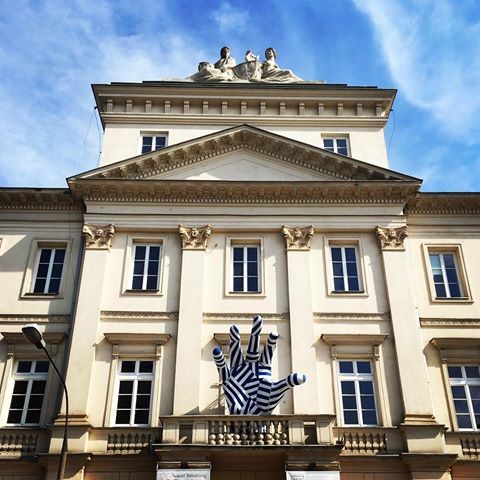
Collegium Nobilium – an elite boarding school for the children of the wealthy nobility, founded in 1740 in Warsaw by the Piarist Order. During the Napoleonic Wars, the building served as a military hospital. After 1814, it served as the headquarters of the Warsaw Charitable Society, followed by the Artillery and Engineers Training School and the Court of Appeals. After World War I, it housed the Supreme Administrative Court, and after World War II – a theatre school.
Muranów. In 1686, the Italian Józef Szymon Bellotti built the Murano Palace (whose the remains were demolished at the turn of the 19th and 20th centuries), which he named to commemorate the island of Murano, part of his native Venice. The first residential settlement was established in this area in the 17th century. From the early 19th century, the area began to be settled by the Jewish population. Before the outbreak of World War II, a quarter of a million people lived there, with Jews constituting about 90% of the population. It was the most densely built-up part of Warsaw. The predominance of the Jewish population influenced the decision to incorporate Muranów into the ghetto during World War II. On November 16, 1940, the ghetto was sealed off and cut off from the outside world, surrounded by a wall enclosing approximately 450,000 inhabitants.
WHO SUPERVISES: Marcin Bikowski, Christoph Lepschy, Katarzyna Minkowska, Kai Ohrem
WHO PARTICIPATES: 14 students (7 from the Theatre Academy + 7 from the Mozarteum)
WHEN: The project will take place during the summer semester of the 2026/2027 academic year and the winter semester of the 2027/2028 academic year. The project involves at least 60 hours of classes per academic year. Tentative schedule: early March 2027 and early October 2027. (Alternative dates: second half of April 2027 and second half of November 2027).
HOW IT WORKS: Each semester includes one week of joint classes in Warsaw and one week of joint classes in Salzburg. We work in a group of 14 people, who will cooperate as well in smaller teams of 3 or 4 persons. Working language: English.
OUTCOME: A presentation of work results in the “Quick&Dirty” format; that is, an informal presentation of the stage of work that has been completed.
BENEFITS: Genuine collaboration of Theatre students from Warsaw / Bialystok and Salzburg. Development of dramaturgical skills under the guidance of tutors. Work in an international setting. Production budget. Opportunity to present the project’s results in Warsaw or Salzburg. Opportunity to form an international creative group.
OUR CONTEXT: This international exchange project is part of the project “Improving Access to the Cultural Offer of the Collegium Nobilium Theatre in Warsaw through the Reconstruction and Renovation of the Building and the Modernization of Its Equipment,” implemented under the European Funds for Infrastructure, Climate, Environment 2021–2027 (FEnIKS 2021–2027).
WHAT IS IMPORTANT TO US: The project is implemented under the FENIKS program, which is why attitudes and practices that take into account equal access, social and environmental responsibility, and conscious, ethical conduct in the context of artistic work and international exchange are important to us. We encourage you to develop projects that prioritize inclusivity in the process, sensitivity to the local context, and the sustainable use of available resources, both during the work phase and when presenting the results.
ACCESSIBILITY: Accessibility is a priority for us. We ask applicants to provide information about any special needs related to participation in the project if addressing these needs is necessary for organizing the working process, communication, mobility, accommodation, or the presentation of results. This information will allow us to plan activities in a way that is as appropriate and accessible as possible for all participants.
HOW TO APPLY: Describe your motivation (why do you want to participate, what is your interest in such an international/history research based/site-specific/documentary project, do you have already ideas how to approach the topic) in no more than 3,600 characters (excluding spaces) in English (about a half to one page).
Your application may include visual materials (up to 10 photos, drawings, or photomontages).
The application may include links to texts providing context or inspiration (max. 10 links).
SUBMIT your application to: biuro.kanclerza@e-at.edu.pl by July 15th, 2026.
In your application, please provide: first name, last name, university name, year of study, and field of study.
Don’t forget to inform us of your accessibility needs if your participation in the process requires it—this description is outside the character limit set for the project concept description.
A committee of three teachers set up by both academies will review the applications and make a final selection by end of July 2026 – to be shared right away for better coordination of everyone involved.
